

Support the conversation on the Ocean


RECOMMENDED BOOKS
A la découverte de l'amphore:
Classification et histoire.
Authored by Anne et Jean Pierre Joncheray.
In English, The Discovery of the Amphora.
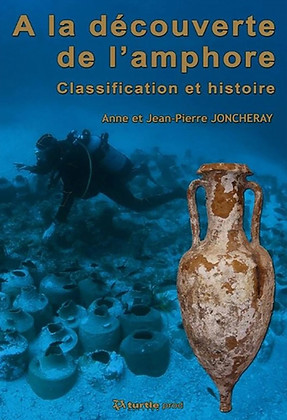
The idea behind presenting this book is fairly simple: to introduce it to readers who may never have heard of it — and quite possibly have never even encountered the subject it explores.
Some of the most interesting books arrive this way. They are not necessarily famous. Their authors are not always widely known. But they are written by people who have spent years — sometimes decades — quietly developing a deep familiarity with their field.
This is one of those books.
The original work is written in French by Anne Joncheray together with her husband Jean-Pierre Joncheray. I came across it while following my usual curiosity for anything connected to the sea. At the time, I was spending a little time in the small Mediterranean port town of Saint-Raphaël, just next to the older and historically rich city of Fréjus. Walking through the town, I noticed that there was an archaeological museum. Being naturally drawn to anything maritime, I walked in without thinking too much about it.
I did not quite know what to expect.
What I discovered was delightful.
The seabed just off that stretch of coastline has, over centuries, become something of an archive. Ships have travelled those waters for thousands of years, carrying cargo across the ancient world. Some of them never completed their journeys. Their remains — cargo, fragments of objects, traces of everyday life — now rest beneath the waters of the Mediterranean Sea.
Much of what the museum displays has been recovered from there.
In other words, a good part of the region’s history has been written not only on land, but also on the seabed.
The museum tells that story very well.
It also turns out that Anne Joncheray, one of the authors of the book, is the director of the museum. From what I could observe — and later confirm through conversations with locals — she and her team do a great deal to keep interest in maritime archaeology alive in the area, not only through scholarship but through community engagement as well.
The book itself, one suspects, is probably only a small glimpse into a much larger body of work.
While spending time in the region, I happened to meet several people who knew her. A few had even gone diving with her. Everyone spoke of her with the same kind of respect that one often hears when someone has truly mastered their craft. She is known as a very experienced diver — someone whose authority comes naturally from long practice and knowledge, and who therefore no longer has anything to prove.
People like that tend to create a calm around them.
It left a strong impression.
I felt fortunate, in a way, to have wandered into the museum that day.
Part of my curiosity had to do with something very familiar to anyone who has grown up around the Mediterranean: amphorae. These ancient clay vessels appear in museums across the region. Often they are found in groups, since ships transporting goods carried dozens of them at a time — and when a ship sank, its amphorae went down with it.
I had always found them fascinating.
Yet despite seeing them repeatedly over the years, I had never quite understood how specialists distinguish them. They appear similar at first glance, yet archaeologists are somehow able to identify their origins, their period of production, and sometimes even the cargo they once carried.
There had to be a system behind it.
So I picked up the book.
And that is exactly what it offers: a way into the world of amphorae.
Gradually, it begins to explain how these vessels can be recognized — how certain shapes correspond to certain regions, how small variations reveal particular historical periods, and how archaeologists are able to read these objects almost the way one reads a text.
What once appeared as rows of identical jars slowly becomes something else entirely: a map of trade, movement, and exchange across the ancient Mediterranean.
The book works as a guide in that sense.
A very enjoyable one, too. It is richly illustrated and written in a way that invites curiosity rather than demanding expertise. One finds oneself returning to it after visiting museums, suddenly noticing details that might previously have gone unnoticed.
And that, perhaps, is its quiet success.
It allows the reader to look again — and to see a little more.
